
The Cloud Has a Thirst Problem

When you upload a photo to the cloud or stream your favorite show, it feels weightless, like the data just floats somewhere in the digital ether. But here’s the reality: the “cloud” is actually thousands upon thousands of physical computers, packed into warehouse-sized buildings, running 24 hours a day. And just like your laptop gets warm when you’re running too many apps at once, these massive server farms generate incredible amounts of heat. Without powerful cooling systems, they would literally melt down. So how do tech companies keep the internet from overheating? The answer is surprisingly old-school: they use water. A lot of it.
Walk into a modern data center and you’ll find rows of servers stretching as far as you can see, all humming with activity. The heat they produce is immense, and keeping them cool requires industrial-scale solutions. The most common method used by the majority of large data centers today is something called evaporative cooling. Think of it as a giant version of those swamp coolers people use in dry climates. Here’s how it works: hot outdoor air gets pulled through wet pads. As the water on those pads evaporates, it cools the air down, which is then blown across the servers. It’s remarkably energy-efficient compared to traditional air conditioning, which is why it’s so popular. But there’s a catch. This method is constantly drinking water and breathing it out as vapor.
Some data centers use air-cooled chillers instead, which work more like the AC unit in your home, using refrigerant to chill the air. These systems often include cooling towers that also rely on water to release heat outside, though they’re sometimes chosen for locations where water is harder to come by. Then there’s the cutting edge: liquid cooling. As computers become more powerful to handle AI processing, air alone can’t keep up. Instead, special fluids are pumped directly to computer chips or servers are actually submerged in cooling liquid. The good news? These systems are often closed-loop, meaning the same liquid gets recycled over and over, using far less water than the evaporative methods.
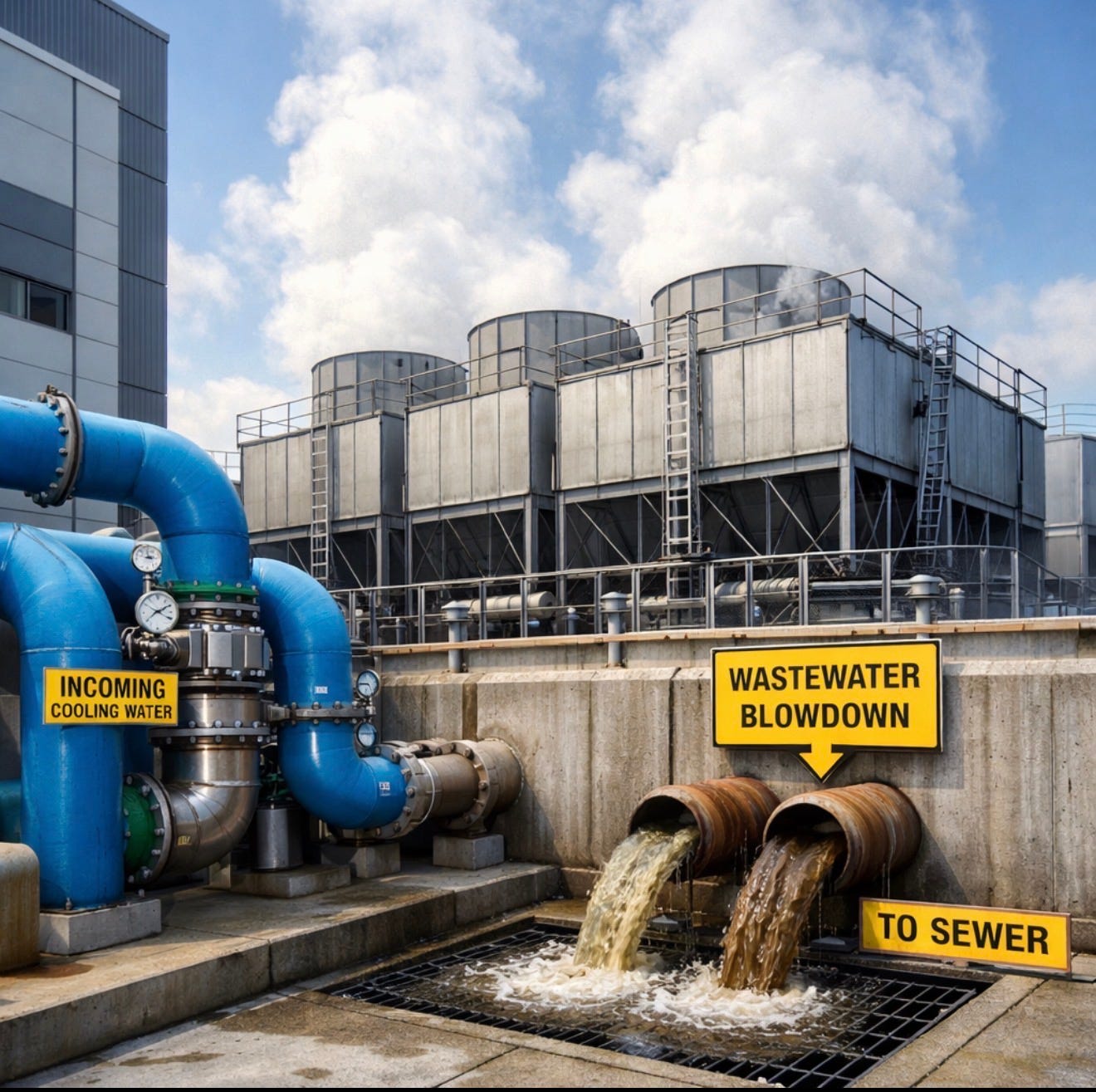
But here’s the part that doesn’t show up in the glossy tech company brochures: most of the water used to cool data centers simply disappears. When a data center uses evaporative cooling or cooling towers, the water doesn’t just circulate and return to where it came from. Instead, somewhere between 70% and 80% of it literally evaporates into thin air. It transforms into water vapor that drifts away as steam. You can sometimes see it: that cloud rising from a data center facility. That’s water leaving the local water system forever. It doesn’t flow back into rivers or reservoirs. It doesn’t return to the municipal water supply. It just vanishes into the atmosphere. The remaining 20-30% doesn’t fare much better. It becomes what’s called “blowdown.” This is water so concentrated with minerals and salts from the cooling process that it can’t be used anymore. This gets flushed into the sewer system as wastewater.
Stay up to date with the industrial world - subscribe for free.
Now, you might be thinking: surely these industrial facilities use industrial water, right? Some recycled or lower-grade water that’s not meant for human consumption? Not quite. The surprising truth is that data centers often use the exact same drinking water that comes out of your kitchen faucet. Why? Because treated municipal water is clean and pure, which means it won’t clog up the sensitive cooling equipment with sediment or algae. Recent industry estimates suggest that 75% to 85% of data centers primarily rely on municipal potable water. Google, for instance, reported that about 78% of its data center water withdrawals in 2024 were potable water. Think about that for a moment: the same water you brush your teeth with is being evaporated by the thousands of gallons to keep servers cool so you can watch cat videos and check your email.
To be fair, the tech industry is beginning to wake up to this issue. Some companies are experimenting with recycled wastewater. This is the kind that flows through purple pipes in water-conscious communities. Others are investing in those closed-loop liquid cooling systems that dramatically cut water consumption. But the reality is that most data centers operating today still follow the old playbook: pull drinking water from the public supply and send most of it skyward as steam. As our appetite for cloud storage, streaming, and AI continues to grow, so does the invisible cost: the water that keeps the internet cool, one evaporated gallon at a time.